Buffalo Ghee vs Cow Ghee: Which is Better for You?
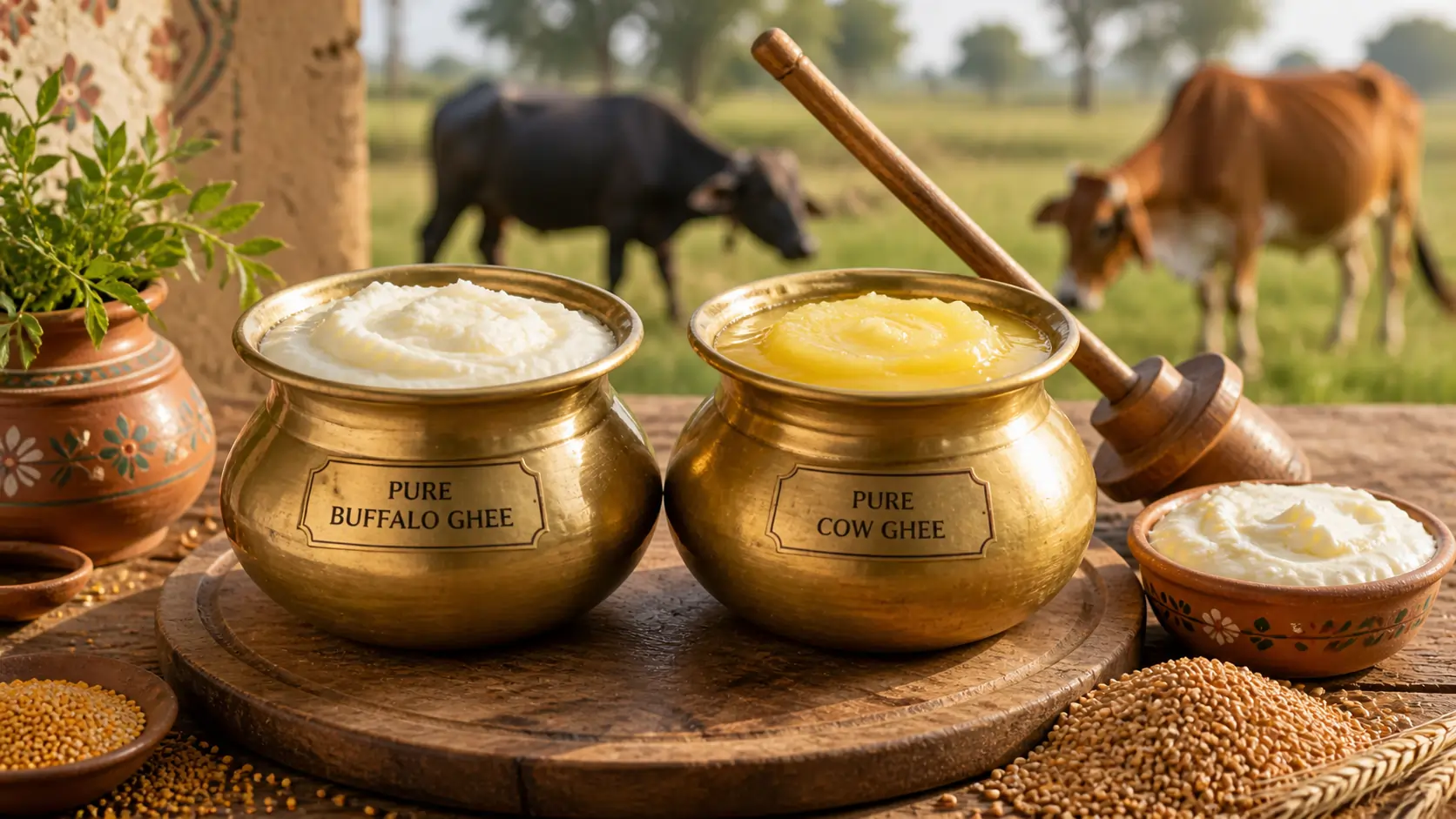
Buffalo ghee contains higher fat content (8-9% vs 4-5% in cow milk), creating richer taste and thicker consistency ideal for traditional Pakistani cooking. Cow ghee offers superior A2 beta-casein protein, easier digestion, and higher omega-3 fatty acids beneficial for heart health. Both are made through the traditional Bilona method, preserving nutrients destroyed in commercial ghee production.
Your choice depends on cooking needs (buffalo for high-heat frying), health goals (cow for cholesterol management), and taste preference (buffalo for robust flavor vs cow’s lighter, nutty taste).
Understanding Desi Ghee: What Makes It Different?
Desi ghee is clarified butter made from milk cream (malai) using traditional hand-churning methods. Unlike commercial ghee (made from butter through direct heating), authentic desi ghee follows the Bilona method:
- Milk curdling: Fresh milk fermented into yogurt (dahi) for 8-12 hours
- Hand-churning: Wooden churner (bilona) extracts butter from yogurt
- Slow heating: Butter simmered on low flame for 45-60 minutes
- Clarification: Water evaporates, milk solids separate, pure golden ghee remains
This ancient 5-step process preserves heat-sensitive nutrients (vitamins A, D, E, K2), beneficial fatty acids (CLA, butyric acid), and creates the distinctive nutty aroma absent in industrial ghee.
Buffalo Ghee vs Cow Ghee: Complete Comparison
| Feature | Buffalo Ghee | Cow Ghee |
|---|---|---|
| Milk Fat Content | 8-9% (double cream richness) | 4-5% (lighter cream) |
| Color | Pure white to pale ivory | Golden yellow (beta-carotene) |
| Texture | Thick, solid at room temp (20-25°C) | Semi-solid, softer consistency |
| Taste | Rich, creamy, robust | Light, nutty, delicate |
| Aroma | Intense buttery fragrance | Mild, sweet, aromatic |
| Smoke Point | 252°C (485°F) | 250°C (482°F) |
| Beta-Casein Protein | A1 & A2 mixed (harder to digest) | A2 only (easier digestion) |
| Cholesterol | 240-260 mg per 100g | 210-230 mg per 100g |
| Saturated Fat | 68-70% | 62-65% |
| Omega-3 Fatty Acids | 0.3-0.5g per 100g | 0.8-1.2g per 100g |
| CLA (Conjugated Linoleic Acid) | 0.5-0.7g per 100g | 0.8-1.2g per 100g |
| Vitamin A | 600-800 IU per 100g | 900-1200 IU per 100g |
| Vitamin K2 | Moderate | High (grass-fed cows) |
| Lactose Content | Trace (0.1%) | Trace (0.1%) |
| Best For | High-heat cooking, traditional recipes, winter warmth | Daily consumption, heart health, Ayurvedic healing |
| Shelf Life (Room Temp) | 12-18 months (thick consistency resists oxidation) | 10-12 months |
| Production Season | Year-round (buffaloes less seasonal) | Peak quality: Winter (grass-fed diet) |
| Price Positioning | Mid-to-premium | Premium (A2, grass-fed factors) |
Buffalo Ghee: The Traditional Powerhouse
Why Buffalo Ghee is Popular in Pakistan
Pakistan has the 3rd largest buffalo population globally (40+ million), making buffalo milk and ghee staples in Punjabi and Sindhi cuisine. Buffalo ghee’s thick consistency and high fat content suit traditional cooking methods requiring richness and heat stability.
Unique Properties of Buffalo Ghee
Higher Fat Content (8-9%):
Buffalo milk naturally contains almost double the fat of cow milk. This translates to:
- Richer, creamier taste
- Thicker ghee consistency (solid at 20-25°C)
- More ghee output per liter of milk (1L buffalo milk = 50-60g ghee vs 40-45g from cow milk)
- Better heat retention in cooked dishes
Superior Heat Stability (252°C Smoke Point):
Buffalo ghee’s saturated fat structure (68-70%) provides exceptional stability at high temperatures without breaking down into harmful compounds. Ideal for:
- Deep frying (pakoras, samosas, jalebi)
- Tandoor cooking
- High-heat sautéing (haleem, nihari, karahi dishes)
Color Difference Explained:
Buffalo milk lacks beta-carotene (precursor to Vitamin A), resulting in pure white ghee. Buffaloes convert all beta-carotene into Vitamin A directly in milk, so buffalo ghee still contains Vitamin A (600-800 IU/100g) despite white color.
Health Benefits of Buffalo Ghee
- High-calorie energy: 112 calories per tablespoon — ideal for active lifestyles, manual labor, cold climates
- Bone health: Calcium (25mg/100g) + Vitamin K (bone mineralization)
- Skin & hair: Topical application moisturizes dry skin, nourishes scalp
- Traditional medicine: Used in Unani and Ayurvedic formulations for strength-building
- Winter warmth: High fat generates body heat in cold months
Best Uses for Buffalo Ghee
✅ Traditional Pakistani cooking: Biryani, haleem, nihari, karahi, korma
✅ Deep frying: Pakoras, samosas, jalebi, gulab jamun
✅ Tandoor/grilling: Naan brushing, tandoori chicken
✅ Winter recipes: Pinni, sohan halwa, moong dal ka halwa
✅ Parathas & rotis: Rich flavor, flaky layers
✅ Massage oil: Warming massage for infants, joint pain relief
❌ Not ideal for: Daily heart health focus (higher cholesterol), weight management (more calories), summer heat (heavy digestion)
Cow Ghee: The Ayurvedic Gold
Why Cow Ghee is Considered Superior in Ayurveda
Ancient Indian medicine considers cow ghee “liquid gold” due to:
- A2 beta-casein protein (easier digestion, less inflammation)
- Higher omega-3 and CLA (heart-protective fatty acids)
- Sattvic properties (promotes mental clarity, calmness)
- Golden color from beta-carotene (antioxidant, eye health)
Unique Properties of Cow Ghee
A2 Beta-Casein Protein:
Indigenous Pakistani cow breeds (Sahiwal, Red Sindhi, Cholistani) produce A2 milk containing beta-casein A2 protein. This differs from A1 protein in hybrid/imported breeds:
| A1 Protein (Hybrid Cows) | A2 Protein (Desi Cows) |
|---|---|
| Forms BCM-7 peptide during digestion | No BCM-7 formation |
| Linked to inflammation, digestive discomfort | Easier digestion, anti-inflammatory |
| May trigger lactose-like symptoms | Better tolerated by sensitive individuals |
| Common in imported Holstein, Friesian breeds | Found in indigenous Pakistani cow breeds |
Higher Omega-3 Fatty Acids (0.8-1.2g/100g):
Grass-fed desi cows produce ghee with 3x more omega-3 than buffalo ghee. Omega-3s:
- Reduce LDL cholesterol, increase HDL
- Lower triglycerides
- Reduce cardiovascular disease risk
- Support brain function and mental health
CLA Content (0.8-1.2g/100g):
Conjugated Linoleic Acid in cow ghee aids:
- Fat metabolism (supports healthy weight management)
- Immune function
- Anti-cancer properties (preliminary research)
- Blood sugar regulation
Golden Color = Beta-Carotene:
Cow ghee’s yellow hue comes from beta-carotene (vitamin A precursor):
- Powerful antioxidant
- Eye health (prevents macular degeneration)
- Skin health (anti-aging properties)
- Immune support
Health Benefits of Cow Ghee
- Heart health: Omega-3 + CLA improve cholesterol profile (raises HDL, lowers LDL)
- Digestive health: Butyric acid (4% of fatty acids) nourishes gut lining, reduces inflammation
- Brain function: Omega-3 supports cognitive performance, memory, mood
- Bone density: Vitamin K2 directs calcium to bones (prevents arterial calcification)
- Anti-inflammatory: A2 protein reduces inflammatory markers vs A1
- Diabetes-friendly: Moderate consumption doesn’t spike blood sugar (pair with fiber)
- Weight management: CLA supports fat metabolism (still calorie-dense — use moderately)
- Immunity boost: Vitamins A, D, E support immune cell function
Best Uses for Cow Ghee
✅ Daily cooking: Low-to-medium heat sautéing, vegetable stir-fries
✅ Dal tempering (tadka): Enhances flavor, aids nutrient absorption
✅ Morning ritual: 1 teaspoon on empty stomach (Ayurvedic practice for digestion)
✅ Bulletproof coffee: 1 tablespoon blended in morning coffee (sustained energy)
✅ Medicinal use: Mixed with turmeric (golden milk), honey (cough remedy)
✅ Baby weaning: Starting at 6+ months (supports brain development)
✅ Skin care: Face moisturizer, lip balm, burn treatment
✅ Ideal for: Heart health focus, weight management, easier digestion, daily wellness
Which Desi Ghee Should You Choose?
Choose BUFFALO GHEE if:
- ✅ You cook traditional Pakistani recipes (biryani, haleem, nihari, karahi)
- ✅ You need high-heat stability (deep frying, tandoor cooking)
- ✅ You prefer rich, robust flavor in food
- ✅ You live in cold climate/winter season (body warming properties)
- ✅ You engage in heavy physical labor (high calorie needs)
- ✅ You want maximum ghee yield from milk production
- ✅ You prioritize thick consistency for parathas/rotis
- ❌ Reconsider if: Managing cholesterol, heart disease history, weight loss goal, summer heat
Choose COW GHEE if:
- ✅ You prioritize heart health and cholesterol management
- ✅ You have digestive sensitivity or inflammation issues
- ✅ You want daily wellness ghee (morning rituals, medicinal use)
- ✅ You follow Ayurvedic principles
- ✅ You prefer lighter, nutty flavor
- ✅ You cook at low-to-medium heat regularly
- ✅ You want higher omega-3 and CLA content
- ✅ You’re managing weight (fewer calories per tablespoon)
- ✅ You need easier digestion (A2 protein)
- ❌ Reconsider if: Budget-conscious (cow ghee costs more), need maximum heat stability, prefer robust flavor
Can You Use Both?
YES! Many Pakistani households keep both:
- Buffalo ghee: Traditional cooking, frying, special occasions
- Cow ghee: Daily use, health focus, children’s food, medicinal purposes
The Bilona Method: Why It Matters
Traditional Bilona Process (5 Steps)
Step 1: Milk Fermentation (8-12 hours)
Fresh milk cultured with yogurt starter at room temperature. Beneficial bacteria (Lactobacillus) develop, creating probiotic-rich dahi.
Step 2: Hand-Churning (30-45 minutes)
Wooden bilona (churner) rotates in dahi using rope-pull method. Mechanical action separates butter globules from buttermilk (chaach). This preserves probiotics destroyed by industrial churning.
Step 3: Butter Washing (Cold Water Rinse)
Extracted butter rinsed in cold water to remove remaining buttermilk (extends shelf life, prevents rancidity).
Step 4: Slow Heating (45-60 minutes)
Butter simmered on low flame (85-95°C) in heavy-bottom pan. Water evaporates first, then milk solids (brown particles) separate and settle at bottom.
Step 5: Clarification & Straining
Once milk solids turn golden-brown and nutty aroma develops, ghee filtered through muslin cloth. Pure golden (cow) or white (buffalo) ghee remains.
Bilona vs Industrial Ghee
| Bilona Method | Industrial Method |
|---|---|
| Yogurt → Butter → Ghee | Cream → Butter → Ghee (skips fermentation) |
| Hand-churned (preserves probiotics) | Machine-churned (heat destroys probiotics) |
| Low-heat simmering (85-95°C) | High-heat processing (120-140°C) |
| Nutrients intact (vitamins, CLA, butyric acid) | Heat-sensitive nutrients degraded |
| Distinct nutty aroma (Maillard reaction) | Bland or artificial flavor |
| Small-batch (quality control) | Mass-produced (consistency varies) |
| 10-12 hours total process | 2-3 hours (efficiency-focused) |
| Premium pricing | Budget-friendly |
Why Bilona costs more: Labor-intensive, time-consuming, requires skill, produces less volume, but delivers superior taste, aroma, and health benefits.
Grass-Fed vs Grain-Fed: The Hidden Quality Factor
Grass-Fed Cow/Buffalo Ghee (Premium Quality)
Diet: Natural pasture grasses, seasonal fodder, minimal grain supplementation
Benefits:
- Higher omega-3 fatty acids (3-5x more than grain-fed)
- More CLA (2-3x higher)
- Richer in Vitamins A, E, K2
- Better fatty acid ratio (omega-3:omega-6 closer to 1:1)
- Golden color intensity (more beta-carotene)
Season: Winter ghee from grass-fed animals is highest quality (cows/buffaloes graze on fresh winter grasses, produce nutrient-dense milk)
Grain-Fed Ghee (Standard Commercial)
Diet: Concentrated feed (wheat, maize, soy), minimal grazing
Characteristics:
- Lower omega-3 content
- Higher omega-6 (inflammatory when imbalanced)
- Less vibrant color
- Still nutritious but less therapeutic potency
Organic Point Sourcing: Village-raised animals with seasonal grazing access (semi-grass-fed) — better than purely grain-fed commercial ghee.
Storage & Shelf Life
Optimal Storage (Both Types)
Temperature: 18-25°C (room temperature) — ghee naturally shelf-stable
Container: Glass jar with airtight lid (avoid metal — ghee’s acidity causes corrosion)
Location: Dark cupboard/pantry (light degrades vitamins)
Avoid: Refrigeration (unnecessary, causes hardening), heat sources, moisture exposure
Shelf Life Comparison
| Storage Condition | Buffalo Ghee | Cow Ghee |
|---|---|---|
| Room Temperature (Airtight) | 12-18 months | 10-12 months |
| Refrigerated | 18-24 months | 15-18 months |
| Frozen | 2-3 years | 2-3 years |
Why buffalo lasts longer: Higher saturated fat (68-70%) resists oxidation better than cow ghee (62-65% saturated fat).
Signs of spoilage:
- Rancid smell (sour, unpleasant)
- Off-taste (bitter, stale)
- Mold growth (moisture contamination)
- Color change (darkening, discoloration)
Note: Properly stored ghee rarely spoils — its low moisture (<0.5%) and high fat content create hostile environment for bacteria.
Cooking Applications: Heat Tolerance Guide
Smoke Point Comparison
| Cooking Fat | Smoke Point |
|---|---|
| Buffalo Ghee | 252°C (485°F) |
| Cow Ghee | 250°C (482°F) |
| Extra Virgin Olive Oil | 160-190°C (320-375°F) |
| Coconut Oil | 177°C (350°F) |
| Butter | 150°C (302°F) |
| Vegetable Oil (Refined) | 230-240°C (446-464°F) |
Why ghee excels: Clarification removes milk solids (burn at low temps), leaving pure fat stable at high heat.
Cooking Method Recommendations
Deep Frying (180-190°C):
✅ Buffalo ghee (higher smoke point, richer flavor)
✅ Cow ghee (suitable but more expensive for frying)
High-Heat Sautéing/Stir-Frying (160-180°C):
✅ Both equally excellent (choose based on flavor preference)
Medium-Heat Cooking (120-150°C):
✅ Cow ghee ideal (preserves delicate omega-3s, lighter flavor)
Low-Heat/Finishing (Below 100°C):
✅ Cow ghee (nutritional benefits preserved, enhances dal, vegetables)
Baking (150-180°C):
✅ Both work (buffalo for rich pastries, cow for lighter cakes)
Nutritional Comparison (Per 100g)
| Nutrient | Buffalo Ghee | Cow Ghee |
|---|---|---|
| Calories | 900 kcal | 900 kcal |
| Total Fat | 100g | 100g |
| Saturated Fat | 68-70g | 62-65g |
| Monounsaturated Fat | 25-27g | 28-30g |
| Polyunsaturated Fat | 3-4g | 4-5g |
| Omega-3 Fatty Acids | 0.3-0.5g | 0.8-1.2g |
| Omega-6 Fatty Acids | 2-3g | 2.5-3.5g |
| CLA | 0.5-0.7g | 0.8-1.2g |
| Butyric Acid | 3-4% | 4-5% |
| Cholesterol | 240-260mg | 210-230mg |
| Vitamin A | 600-800 IU | 900-1200 IU |
| Vitamin D | 15 IU | 15 IU |
| Vitamin E | 2.5mg | 3mg |
| Vitamin K2 | Moderate | High (grass-fed) |
| Moisture Content | <0.5% | <0.5% |
Daily Consumption Guidelines
Recommended Amounts
Adults (Healthy):
- Buffalo ghee: 1-2 teaspoons daily (high calorie density)
- Cow ghee: 1-2 tablespoons daily (lighter, more digestible)
Children (2+ years):
- Both types: 1 teaspoon daily (supports brain development, bone growth)
Infants (6-12 months):
- Cow ghee only: ¼ teaspoon mixed in food (A2 protein easier for developing gut)
- Avoid buffalo ghee for infants (heavier digestion)
Athletes/Active Individuals:
- Buffalo ghee: Up to 3 tablespoons daily (high-calorie fuel)
- Cow ghee: 2-3 tablespoons daily (recovery support)
Weight Management:
- Both types: Limit to 1 teaspoon daily (monitor total calorie intake)
Safety Notes
✅ Safe For:
- Adults in moderation (1-2 tablespoons daily)
- Children 2+ years (supports growth)
- Infants 6+ months (cow ghee only, A2 easier digestion)
- Pregnant/nursing women (nutrient-dense, energy source)
- Lactose-intolerant individuals (trace lactose removed during clarification)
⚠️ Use With Caution:
- High cholesterol: Limit to 1 teaspoon daily, choose cow ghee (lower cholesterol content)
- Heart disease: Consult cardiologist — omega-3 in cow ghee may benefit, but saturated fat requires monitoring
- Weight management: Track calories (112 kcal per tablespoon)
- Diabetes: Moderate amounts okay (no blood sugar spike), pair with fiber
❌ Avoid/Limit:
- Severe cardiovascular disease: Without doctor approval (high saturated fat)
- Obesity: Limit to ½ teaspoon daily (calorie-dense)
- Milk protein allergy: Trace proteins may trigger reactions (rare but possible)
Frequently Asked Questions
Shop authentic Bilona desi ghee at Organic Point. Choose buffalo ghee for traditional cooking and robust flavor, or cow ghee for daily wellness and heart health. Village-sourced, hand-churned, A2 verified. Delivered fresh all over Pakistan.