Natural Crystallization & De-Crystallization of Pure Honey
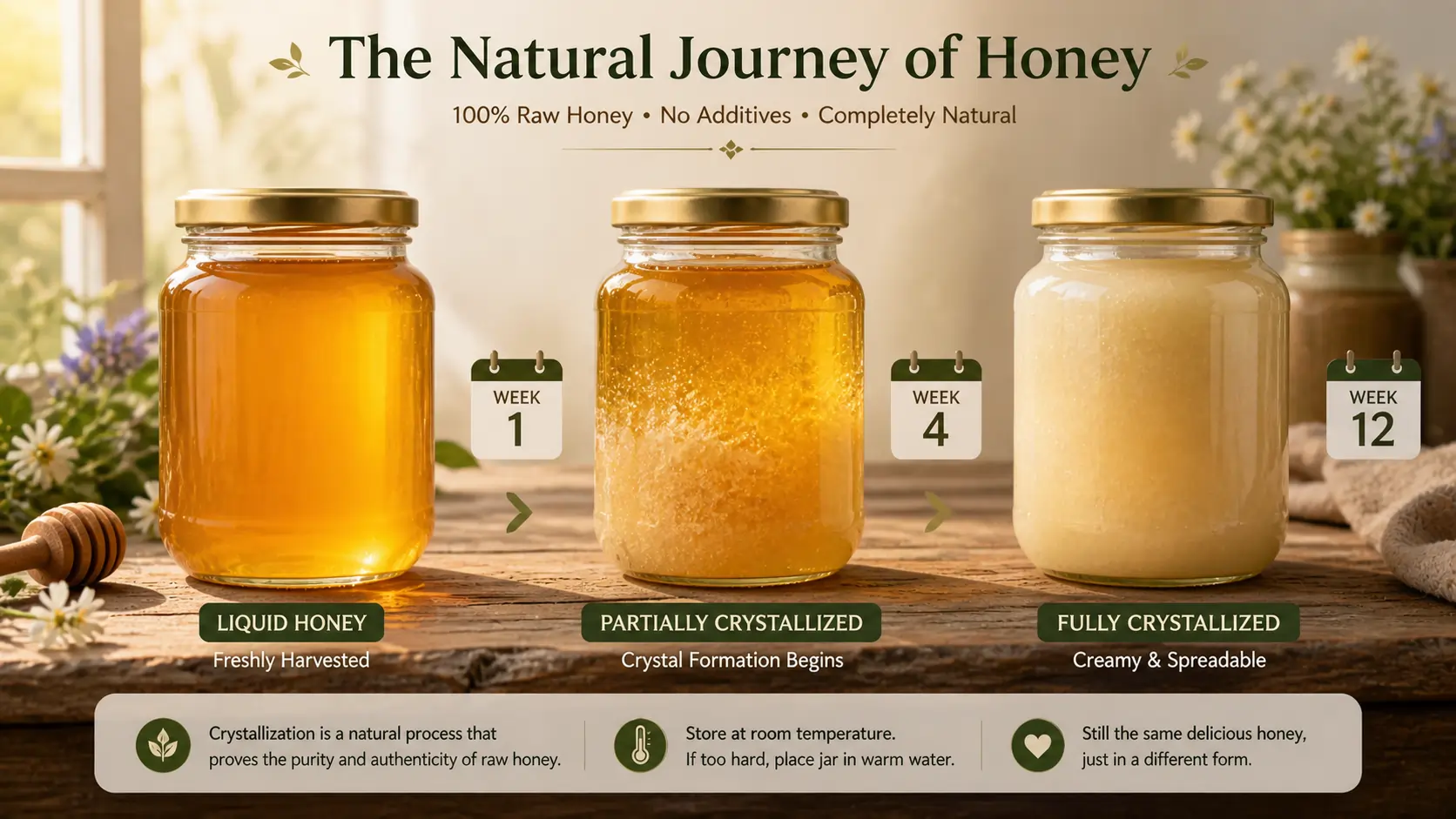
Honey crystallization is a natural process proving purity, not a sign of fake or adulterated honey. Pure raw honey contains 70-80% natural sugars (glucose and fructose) and only 17-20% water, creating a supersaturated solution. Over time, glucose molecules separate from water and form crystals, transforming liquid honey into a thick, grainy texture. This happens faster in honey with high glucose content (multifloral honey crystallizes in 3-6 months) and slower in high-fructose varieties (Robinia honey stays liquid 12-18 months). Crystallization does not reduce honey’s nutritional value, enzymes, or antibacterial properties. It simply changes physical state from liquid to semi-solid.
What Is Honey Crystallization? (The Science Explained Simply)
Crystallization occurs when glucose (one of honey’s two main sugars) separates from the water in honey and forms solid crystals. Think of it like sugar crystals forming at the bottom of a sweet tea glass when it cools — except honey’s process happens more slowly over weeks or months.
Honey’s Chemical Composition:
- 70-80% sugars: Glucose (30-40%) + Fructose (38-44%)
- 17-20% water: Low moisture creates supersaturation
- 2-3% vitamins, minerals, enzymes, pollen: Nutritional compounds
Supersaturation means honey contains more dissolved sugar than water can normally hold. This unstable state eventually triggers glucose to crystallize, especially when:
- Temperature drops below 14°C (glucose becomes less soluble)
- Tiny particles (pollen, dust, air bubbles) provide nucleation points
- Honey sits undisturbed for weeks/months
Why Does Honey Crystallize? 5 Key Factors
1. Glucose-to-Fructose Ratio
| Honey Type | Glucose % | Fructose % | Crystallization Speed |
|---|---|---|---|
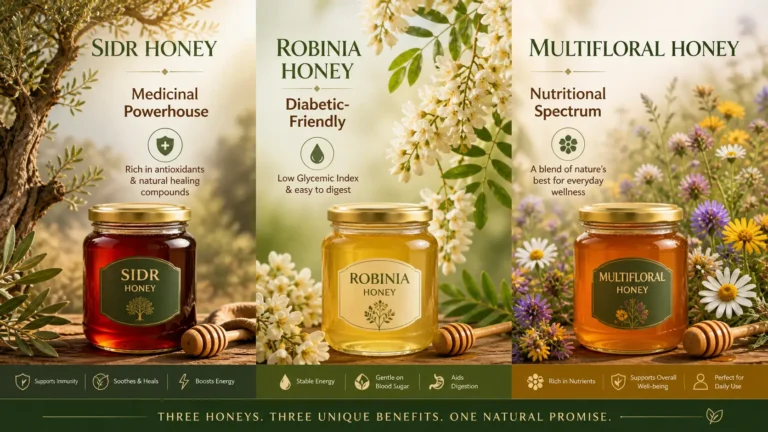
| Multifloral Honey | 33-35% | 40-42% | Fast (3-6 months) |
| Sidr Honey | 31-33% | 38-40% | Medium (6-12 months) |
| Robinia Honey | 27-29% | 44-46% | Very slow (12-18 months) |
High glucose = faster crystallization (glucose forms crystals easily)
High fructose = stays liquid longer (fructose resists crystallization)
2. Temperature
- Optimal crystallization temperature: 10-18°C (50-64°F)
- Freezing (below 0°C): Slows crystallization (honey too thick to move)
- Warm storage (above 25°C): Prevents crystallization (glucose stays dissolved)
- Room temperature (20-25°C): Moderate crystallization over months
Pakistan climate note: In hot summer months (35-45°C), honey rarely crystallizes. Winter temperatures (10-20°C) trigger faster crystallization.
3. Pollen and Particles
Raw, unfiltered honey contains:
- Pollen grains: Provide nucleation sites where crystals start forming
- Beeswax particles: Tiny fragments from honeycomb
- Air bubbles: Trapped during extraction
These particles act as “seeds” around which glucose crystals grow. Ultra-filtered commercial honey (pollen removed) crystallizes slower but loses health benefits.
4. Moisture Content
- Low moisture (15-17%): Faster crystallization (more concentrated glucose)
- High moisture (19-21%): Slower crystallization (more dilute solution)
Well-stored raw honey has 16-18% moisture — ideal for preserving enzymes but also conducive to natural crystallization.
5. Honey Source (Flower Type)
Fast-Crystallizing Honeys:
- Multifloral/wildflower honey (high glucose from diverse sources)
- Mustard honey (very high glucose)
- Clover honey (moderate-high glucose)
Slow-Crystallizing Honeys:
- Robinia/Acacia honey (very high fructose)
- Sidr honey (balanced but leans fructose)
- Tupelo honey (rare, extremely high fructose)
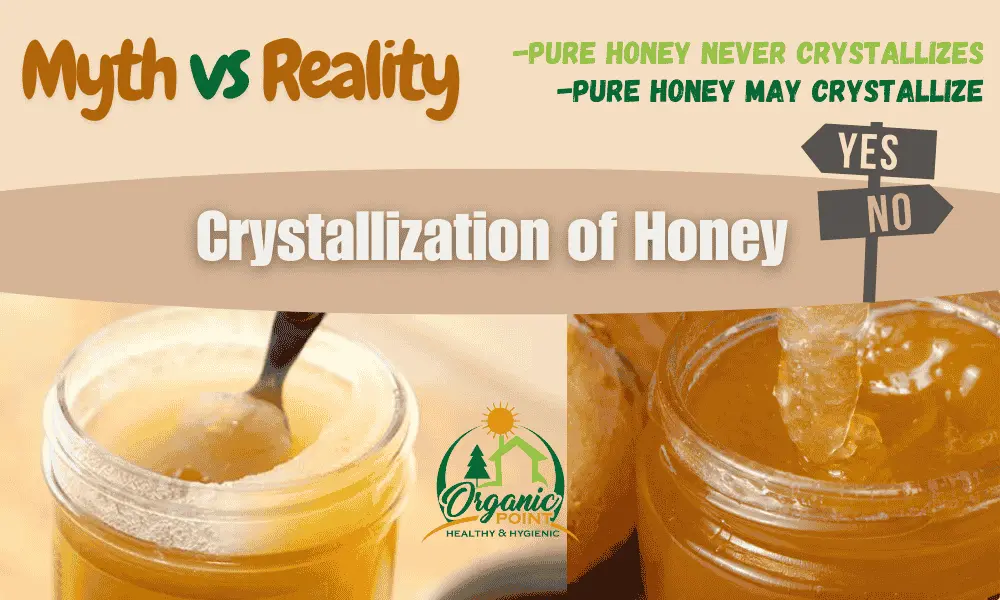
Is Crystallized Honey Fake? Debunking the Pakistani Myth
❌ MYTH: “Crystallized honey is mixed with sugar or impure”
✅ TRUTH: Crystallization proves honey is pure and raw. Here’s why:
- Fake honey doesn’t crystallize: Adulterated honey (mixed with corn syrup, glucose syrup, or inverted sugar) stays liquid indefinitely because added syrups have different chemical structures preventing natural crystallization.
- Heat-treated honey resists crystallization: Commercial honey processors heat honey to 70-80°C to delay crystallization for shelf appeal. This destroys beneficial enzymes (diastase, invertase), vitamins, and antibacterial compounds.
- Raw honey MUST crystallize eventually: If honey stays perfectly liquid for years without refrigeration, it’s likely been heavily processed or adulterated.
Pakistani Consumer Confusion:
In Pakistan, many believe:
- “If honey becomes like ghee (solid/grainy), it’s fake”
- “Good honey stays liquid forever”
- “Crystallization means water or sugar was added”
The scientific reality: These beliefs are backwards. Crystallization indicates authenticity, not adulteration.
Types of Honey Crystallization (Texture Variations)
Not all crystallized honey looks the same. Crystal size and texture depend on glucose content, temperature, and storage conditions:
Fine Crystallization (Smooth, Creamy)
- Appearance: Smooth, spreadable texture like soft butter or ghee
- Crystal size: Tiny (under 25 microns)
- Common in: Multifloral honey, clover honey
- Why: Fast crystallization at cool temperatures creates many small crystals
Coarse Crystallization (Grainy, Crunchy)
- Appearance: Large, visible sugar-like granules; gritty texture
- Crystal size: Large (50+ microns)
- Common in: Honey stored at fluctuating temperatures
- Why: Slow crystallization allows fewer but larger crystals to form
Partial Crystallization (Separated Layers)
- Appearance: Solid crystallized bottom, liquid top layer
- Common in: Tall jars stored upright
- Why: Glucose crystals settle at bottom; fructose-rich liquid floats on top
All three forms are completely normal and safe. Texture preference is personal — some prefer creamy crystallized honey for spreading on toast, others prefer liquid honey for tea.
How to De-Crystallize Honey (Safe Method)
If you prefer liquid honey, reverse crystallization without destroying nutrients:
Gentle Water Bath Method (Recommended):
Step 1: Fill bowl or pot with warm water (40-45°C / 104-113°F)
Step 2: Remove honey jar lid (allows heat to penetrate)
Step 3: Place jar in warm water bath
Step 4: Let sit 15-20 minutes, stirring honey occasionally
Step 5: Check consistency — crystals should dissolve back into liquid
Step 6: If still crystallized, replace water and repeat
Critical temperature rule: Never exceed 40°C (104°F)
- Above 40°C: Heat-sensitive enzymes (diastase, invertase) begin degrading
- Above 60°C: Creates HMF (hydroxymethylfurfural) — quality indicator of overheating
- Boiling water (100°C): Destroys all medicinal properties, turns honey into sugar syrup
❌ Methods to AVOID:
Microwave: Uneven heating creates hot spots above 60°C, destroying enzymes even if average temperature seems safe
Direct stove heating: Extremely difficult to control temperature — almost always overheats honey
Boiling water bath: Too hot (100°C) — see above
Does Crystallized Honey Lose Nutritional Value?
NO. Crystallization is purely a physical change (liquid → solid), not a chemical change. All nutrients remain intact:
✅ Enzymes preserved: Diastase, invertase, glucose oxidase
✅ Antioxidants unchanged: Polyphenols, flavonoids
✅ Antibacterial properties maintained: MGO (methylglyoxal) levels stable
✅ Vitamins intact: B-complex vitamins, Vitamin C traces
✅ Minerals present: Potassium, calcium, magnesium, iron
The ONLY change: Physical texture from liquid to semi-solid. Think of it like water freezing into ice — the H₂O molecules don’t disappear, they just rearrange.
How to Prevent or Slow Honey Crystallization?
If you prefer honey to stay liquid longer:
Storage Temperature: Keep at 25-30°C (77-86°F) — warm cupboard away from refrigerator
Container Type: Glass jar with airtight lid (minimizes air exposure, which introduces moisture fluctuations)
Avoid Temperature Fluctuations: Don’t move honey between hot/cold locations repeatedly
Choose High-Fructose Honey: Robinia/Acacia honey naturally resists crystallization (stays liquid 12-18+ months)
Note: Even with perfect storage, all pure raw honey will eventually crystallize. It’s inevitable for authentic honey.
Does Pure Honey Expire?
No, pure honey never spoils. Archaeological discoveries in Egyptian tombs found 3,000-year-old honey still edible. Here’s why:
Natural Preservatives in Honey:
- Low moisture (16-18%): Bacteria cannot survive in this dry environment
- Acidic pH (3.5-4.5): Inhibits microbial growth
- Hydrogen peroxide: Produced naturally by glucose oxidase enzyme — kills bacteria
- High sugar concentration: Creates osmotic pressure fatal to microorganisms
Changes Over Time (Normal, Not Spoilage):
- Color darkening: Honey may deepen from golden to dark amber (Maillard reaction — natural aging)
- Crystallization: As explained above — physical change, not expiration
- Aroma mellowing: Floral notes may fade slightly; honey becomes less aromatic
- Flavor shift: May taste less sweet as aromatic compounds dissipate
Signs of ACTUAL spoilage (rare, only if contaminated):
- Fermentation: Foamy bubbles, sour/alcoholic smell (happens only if moisture >20%)
- Mold growth: Visible fuzzy growth on surface (requires moisture contamination)
Properly stored raw honey (airtight, dry, clean) lasts indefinitely — decades or centuries.
Crystallization FAQs
So, when your Organic Point honey crystallizes, don’t worry. You’ve purchased genuine raw honey with full medicinal properties intact. Simply warm gently using the water bath method, or enjoy the rich, creamy crystallized texture.